
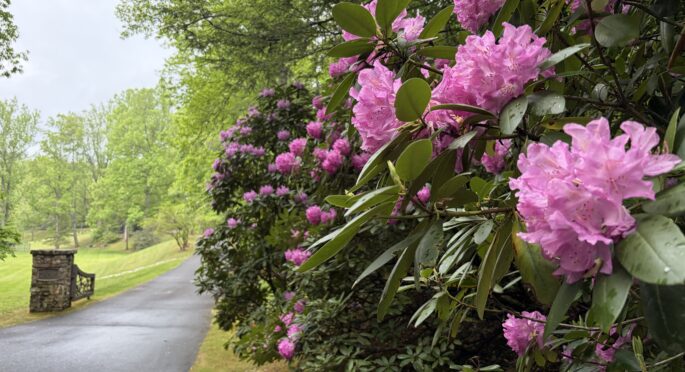
On my lengthy, 300-yard commute to work this morning I took a moment in the misty, much needed rain, to take in the view. All along the driveway the green of our temperate rainforest is peppered with flashes of pink and purple, thanks to our many wildflowers, mountain laurel, and mostly Rhododendron.
Rhododendrons are near the top of my list for favorite plants. Right up there with Hemlocks along Illahee road and the live oaks of my childhood along the coast of North Carolina.
Most scientists agree that they have been here in the southern Appalachian (App-uh-latch-un) Mountains for millions of years. Their resiliency is unmatched, thriving in some of the most scenic and breathtaking peaks around from Roan Mountain to the Grayson Highlands. Many thousand feet lower, and far less exposed to the wind and rain, they grace our campus with walls of green, brown, and in this time of year, purple goodness.
This past January, we had a decent snow in Brevard. Beyond sledding with the neighborhood kids, I especially enjoyed morning walks in the quiet, taking in the stillness of the landscape, freshly painted white. Amongst the green and white, I noticed how the Rhododendron looked nearly dead, pointing their leaves down, curled up as if to say, “We’ve just got to hang on until spring.” I think of the times after one of those hectic days when I pick up the phone with one hand, while holding a baby in the other, and playing defense against a rambunctious toddler, and hear someone asking, “How’s it going?” and the best I can say is “we’re hanging in there.”
Months later, the droopy, self-protected leaves, reach out and up standing tall. Their once small buds burst forth with colors of purple, pink, and white as if to shout, “We’re here, we survived the year, and we’re going to make this world a bit more beautiful.”
As much as we embrace nature, we often forget that cycles and seasons are normal. In fact, they’re necessary. From the trees that shade us to the water that nourishes us, cycles exist to sustain. For parents and campers alike, there are days when we feel like that snowy rhododendron, doing everything we can, adjusting our leaves to not break under the weight of a sometimes-crushing world. I hear about those days, and I experience it firsthand. It’s then when I recall the adage, “This too, shall pass.” Thank goodness it always does.
Last summer during the July session I led a fishing trip (nothing was caught) for a group of eighth graders. It was the second to last day of camp and many of them lamented how much they would miss Illahee when they returned home. “Home isn’t bad or anything and I actually don’t mind being busy at school,” one camper remarked, “It’s just at Illahee, I’m not busy, I’m not tired, I can just be. It’s just a different feeling.”
For many of our campers and staff alike, Illahee is its own season.
In the next few weeks, the rhododendron flowers will fade and fall. The good news is that the joy they brought will be replaced by the contagious energy of nearly three hundred young women who also have come to say, “We’re here, we’ve survived the [school]year and we’re ready to make this world a bit more beautiful.”
See y’all soon.
Lucas